



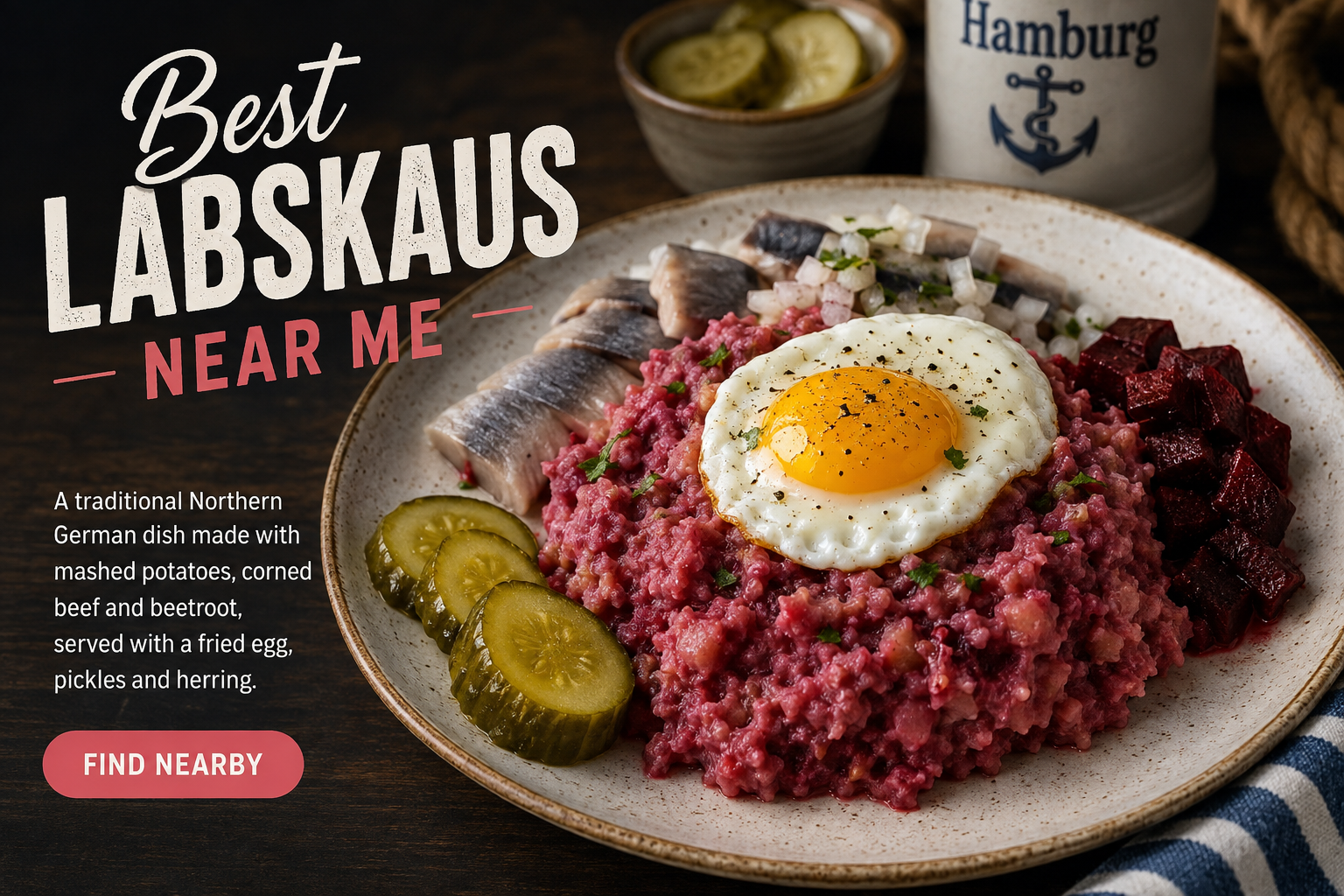
If you are searching for the Best Labskaus Near Me, you may already know that this unusual-looking dish has a fascinating history. Labskaus is a traditional Northern European meal most strongly associated with northern Germany, particularly Hamburg and other coastal areas. It is a hearty dish made from simple ingredients, traditionally including potatoes, corned beef, and beetroot.
The dish is particularly recognizable because of its distinctive pink or reddish colour. Traditional servings may also include a fried egg, pickled vegetables, and herring or matjes. Although recipes vary considerably, the combination of mashed potatoes, meat, and beetroot is strongly associated with the familiar northern German style.
Finding authentic Labskaus in the UK can be more difficult than finding better-known German dishes such as bratwurst, schnitzel, or sauerkraut. However, German restaurants, Northern European food events, specialist menus, and restaurants serving regional German cuisine can sometimes provide opportunities to try it.
This guide explains what Labskaus is, where it comes from, what it tastes like, what to look for when searching for the Best Labskaus Near Me, and how to recognize a traditional-style preparation.
Quick Facts Table
| Fact | Details |
|---|---|
| Dish | Labskaus |
| Cuisine | Northern European / Northern German |
| Strong association | Hamburg and northern Germany |
| Main ingredients | Potatoes, corned beef, beetroot |
| Common accompaniments | Fried egg, pickles, herring or matjes |
| Appearance | Pink or reddish mashed mixture |
| Texture | Soft, mashed, and hearty |
| Flavour | Savoury, earthy, salty, and tangy |
| Historical connection | Maritime and seafaring communities |
| Recipe variation | Considerable regional and household variation |
| Best-known German association | Hamburg |
| UK availability | Relatively uncommon compared with mainstream German dishes |
What Is Labskaus?
Labskaus is a traditional dish from Northern Europe that is particularly associated with northern Germany. Hamburg is one of the places most closely connected with the dish, although similar preparations and related food traditions have existed across northern maritime regions.
At its simplest, Labskaus consists of cooked potatoes combined with meat and beetroot. The ingredients are usually mashed or combined into a soft mixture. Traditional versions often use corned beef, although historical recipes and modern interpretations can differ.
The finished dish is immediately recognizable because of its colour. Beetroot gives the potato mixture a pink, red, or reddish-purple appearance. This makes Labskaus visually distinctive and sometimes surprising to people who have never encountered it before.
A traditional serving may be accompanied by a fried egg, pickles, and herring or matjes. These additions are important because they provide contrasting flavours. The soft potato and meat mixture can be complemented by the acidity of pickles, the richness of egg, and the salty or delicate flavour of fish.
There is no single recipe that can accurately be described as the only authentic version. Labskaus has been prepared in different ways over time, and recipes can vary according to location, family tradition, and available ingredients.
Why Is Labskaus Associated With Hamburg?
Hamburg has a long maritime history, and Labskaus became closely associated with the city’s traditional food culture. Its connection with sailors and coastal communities is an important part of the dish’s identity.
Historically, food for long journeys needed to be practical and relatively easy to store. Ingredients such as potatoes, salted or preserved meat, pickled foods, and preserved fish were useful in maritime settings. This helped create a food tradition based on ingredients that could provide substantial nourishment without requiring complicated preparation.
Hamburg’s position as a major port also helped make the city an important centre for maritime food culture. Over time, Labskaus became part of the culinary identity associated with northern Germany.
Today, the dish can be found in traditional German restaurants and regional establishments, particularly those interested in northern German cuisine. It is also sometimes featured as a regional speciality rather than as an everyday menu item.
What Does Traditional Labskaus Taste Like?
If you are looking for the Best Labskaus Near Me, understanding its flavour can help you decide whether the dish is something you would enjoy.
Labskaus is generally hearty and savoury rather than spicy. Potatoes provide the soft, mild base, while corned beef contributes a salty and meaty character. Beetroot adds earthy sweetness as well as the dish’s distinctive colour.
The accompaniments create additional contrasts.
Pickles can introduce acidity and crunch, balancing the soft texture of the main mixture. A fried egg adds richness, while herring or matjes contributes a distinctly maritime flavour.
The overall experience therefore depends not only on the mashed mixture but also on how it is served.
Someone accustomed to familiar German dishes may find Labskaus very different from sausages, schnitzel, or roast dishes. It is more rustic, soft, and visually distinctive.
What Ingredients Are Used in Labskaus?
The exact ingredients depend on the recipe, but traditional northern German-style Labskaus commonly centres around several key components.
Potatoes
Potatoes provide the main starchy foundation. They are generally cooked and mashed or incorporated into the mixture.
The potato helps create Labskaus’s characteristic soft texture and makes the dish filling.
Corned Beef
Corned beef is a familiar ingredient in many traditional versions. It contributes saltiness, meatiness, and a dense texture.
The amount used can vary significantly between recipes. Some versions may be more meat-forward, while others place greater emphasis on the potatoes.
Beetroot
Beetroot is responsible for the distinctive colour associated with many Labskaus preparations.
It also contributes an earthy, slightly sweet flavour. Depending on the quantity used, the finished dish may range from lightly pink to a much deeper red.
Fried Egg
A fried egg is a common accompaniment. The creamy yolk provides richness and creates a contrast with the savoury potato and meat mixture.
Pickles
Pickles provide acidity and crunch. Their sharp flavour can help balance the richness of the main dish.
Herring or Matjes
Herring, including matjes-style preparations, is another traditional accompaniment associated with Labskaus.
Not every restaurant will serve fish with the dish, so it is worth checking the menu before ordering if this is important to you.
Why Is Labskaus Pink?
One of the first things people notice about Labskaus is its colour.
The pink or reddish appearance primarily comes from beetroot. When beetroot is combined with mashed potatoes and the other ingredients, its natural colour spreads throughout the mixture.
The result can look quite unusual, especially to someone seeing the dish for the first time.
However, the colour is an important part of the familiar northern German presentation. A restaurant serving Labskaus may present it as a mound of reddish mash alongside a fried egg, pickles, and fish.
The exact shade depends on the recipe and the amount of beetroot used.
How to Find the Best Labskaus Near Me
Searching for the Best Labskaus Near Me can require a little more research than searching for common dishes.
Labskaus is not widely available on standard menus outside northern Germany. In the UK, German restaurants may focus on more internationally familiar dishes, meaning Labskaus may not appear on the permanent menu.
A useful approach is to search for restaurants specialising in German regional cuisine rather than simply searching for German food.
Look for terms such as:
- Northern German cuisine
- Hamburg cuisine
- Traditional German food
- Hamburg specialities
- Northern European cuisine
- German regional dishes
- Labskaus
- Hamburger Labskaus
Checking the restaurant’s current menu is particularly important. A restaurant may have served Labskaus in the past but not offer it all year.
Labskaus in the UK
For people in the UK, finding traditional Labskaus may take some effort. German cuisine is available in many British cities, but the most common dishes tend to be sausages, schnitzel, pretzels, pork dishes, and other better-known specialities.
Labskaus is much more regional.
London is one of the strongest places to investigate because of its large selection of international restaurants and German food venues. Other cities with German communities, international food scenes, or German cultural events may also occasionally offer regional dishes.
Liverpool is another interesting location when researching northern maritime food traditions. The city has its own historic food called scouse, which is related in name and culinary history to the broader maritime food culture surrounding dishes such as Labskaus. However, scouse and Labskaus should not simply be treated as identical dishes.
If you are specifically looking for authentic Labskaus, always check whether a venue is serving Labskaus itself rather than a different dish with a similar maritime history.
What Makes a Good Labskaus?
There is no universal scoring system for Labskaus, but several characteristics can help you evaluate a traditional-style serving.
First, the potato mixture should have a soft and cohesive texture without becoming excessively watery.
The meat should provide a noticeable savoury flavour without completely overwhelming the potatoes.
Beetroot should contribute its characteristic earthy sweetness and colour.
The accompaniments should also complement the main mixture. Pickles can add acidity, while a fried egg adds richness. Herring or matjes can provide another layer of flavour and reinforce the dish’s northern maritime character.
Most importantly, a good Labskaus should feel balanced. Because the ingredients are relatively simple, the quality and preparation of each component can make a noticeable difference.
Traditional Labskaus vs Modern Versions
Modern restaurants sometimes adapt traditional dishes to suit contemporary tastes. Labskaus is no exception.
A restaurant might alter the proportions of potato, meat, or beetroot. Some versions may use alternative meats or vegetarian ingredients. Presentation can also vary considerably.
These adaptations are not necessarily a problem. Food traditions naturally change over time.
However, if your goal is to experience a traditional Hamburg-style Labskaus, pay attention to the ingredients listed on the menu.
A preparation containing potatoes, corned beef, beetroot, fried egg, pickles, and herring or matjes will generally be closer to the familiar traditional presentation than a heavily modernized interpretation.
Is Labskaus the Same as Corned Beef Hash?
Labskaus can look somewhat similar to corned beef hash because both can contain potatoes and corned beef.
However, they are not simply the same dish.
The inclusion of beetroot gives traditional Labskaus a distinctive colour and flavour. Traditional accompaniments such as pickles, fried egg, and herring or matjes also make the dish different from a standard corned beef and potato hash.
The preparation method can vary as well.
So, while there are similarities between the dishes, Labskaus has its own culinary identity and historical context.
Is Labskaus Healthy?
The nutritional value of Labskaus depends heavily on the recipe and portion size.
Potatoes provide carbohydrates, while meat and egg contribute protein and fat. Beetroot provides vegetables and naturally occurring nutrients. Pickles and herring can add additional flavours and nutrients, but they may also contribute significant amounts of sodium depending on the preparation.
Corned beef is generally a processed and salty meat, so people monitoring their sodium intake may want to consider the portion and recipe.
It is therefore better to think of Labskaus as a traditional hearty meal rather than automatically classifying it as either a “healthy” or “unhealthy” dish.
How Labskaus Is Usually Served
Presentation varies from restaurant to restaurant.
A common presentation places the mashed Labskaus mixture on a plate with a fried egg on top or alongside it. Pickles may be arranged around the dish, while herring or matjes can be served separately.
The strong red or pink colour of the potato mixture makes the plate immediately recognizable.
Some restaurants may present the components separately rather than mixing everything together. This can make it easier for diners to experience the flavours individually.
If you are trying Labskaus for the first time, the traditional accompaniments are worth experiencing because they are an important part of the dish’s character.
Why People Search for the Best Labskaus Near Me
Interest in traditional regional food has made dishes like Labskaus increasingly interesting to travellers and food enthusiasts.
People may search for the Best Labskaus Near Me because they want to experience authentic German cuisine beyond the most familiar dishes.
For some diners, the attraction is the history. For others, it is the unusual appearance or combination of ingredients.
Labskaus also appeals to people interested in maritime food traditions because its history is closely connected with northern European coastal culture.
Rather than being a complicated fine-dining creation, Labskaus represents a style of cooking based on practical ingredients and satisfying meals.
Tips for Ordering Labskaus for the First Time
If you find Labskaus on a UK restaurant menu, check exactly what comes with it.
Ask whether the dish includes:
- Corned beef
- Mashed potatoes
- Beetroot
- Fried egg
- Pickles
- Herring or matjes
Not every version includes all of these components.
You can also ask whether the restaurant’s recipe is based on a northern German or Hamburg-style preparation.
If you are unfamiliar with herring or matjes, you may want to ask whether the fish is served separately. This allows you to try the main Labskaus mixture first.
The Cultural Importance of Labskaus
Labskaus is more than a mixture of potatoes, meat, and beetroot. It represents a broader northern European food tradition shaped by geography, trade, preservation, and maritime life.
Coastal communities historically depended on foods that could be stored and transported. This influenced the development of many dishes across northern Europe.
Labskaus became particularly associated with sailors and port cities, and Hamburg remains one of its best-known cultural homes.
Its continued presence on traditional menus demonstrates how regional dishes can survive even when modern eating habits change.
Today, Labskaus can be viewed as both a comfort food and a piece of northern German culinary heritage.
Final Thoughts on the Best Labskaus Near Me
Finding the Best Labskaus Near Me may require more searching than finding mainstream German dishes, particularly in the UK. However, that rarity is part of what makes trying authentic Labskaus interesting.
A traditional-style version is built around a simple combination of mashed potatoes, corned beef, and beetroot, often accompanied by fried egg, pickles, and herring or matjes. The beetroot gives the dish its characteristic colour, while the accompaniments provide contrasting flavours and textures.
There is no single recipe that represents every Labskaus preparation. Regional and family recipes can differ, and modern restaurants may introduce their own interpretations.
If you want the most traditional experience, look for a restaurant or food venue with a connection to Northern German or Hamburg cuisine, and always check the current menu before travelling.
For food lovers, Labskaus offers an opportunity to explore a lesser-known side of German cuisine. It is simple, filling, colourful, and closely connected to the maritime history of northern Europe. Whether you discover it at a specialist German restaurant, a regional food event, or during a trip to northern Germany, Labskaus is a dish worth trying for anyone interested in authentic regional food traditions. hey daily