



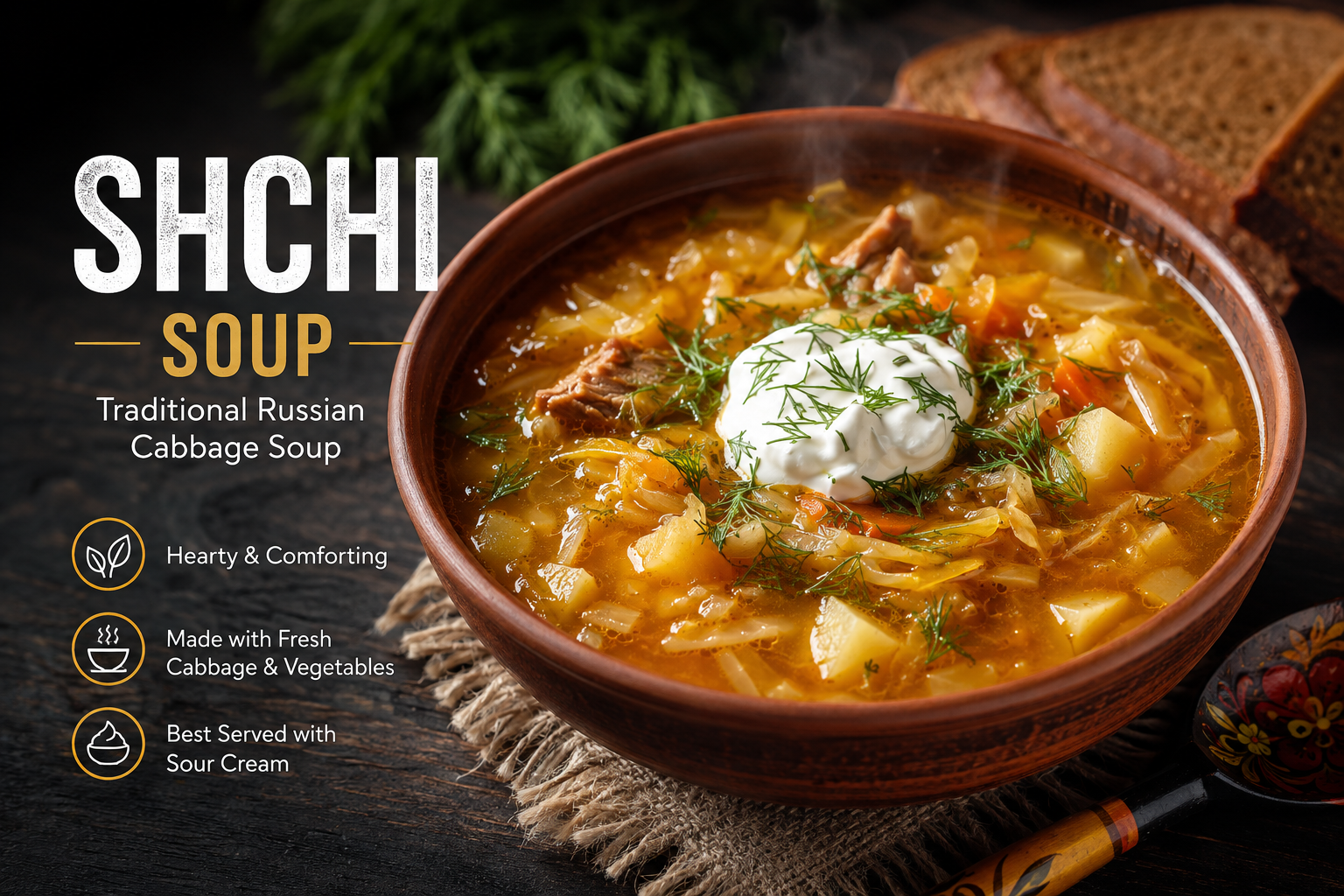
If you are searching for shchi soup near me, you are probably looking for a warm, comforting cabbage soup with roots in Russian and Eastern European cooking. Shchi, written as щи in Russian, is traditionally associated with cabbage-based soups and can be prepared in many different ways. Depending on the recipe, it may contain fresh cabbage, fermented cabbage, meat, potatoes, carrots, onions, herbs, mushrooms, or other vegetables.
Unlike a single fixed recipe, shchi represents a broad family of soups. Some versions are rich and meaty, while others are vegetarian and relatively light. Sour cabbage can give certain versions a distinctive tangy flavour, while fresh cabbage produces a milder and sweeter profile. Sour cream, commonly known as smetana in Russian cuisine, is also a traditional accompaniment.
For anyone searching for shchi soup near me, understanding what makes the soup distinctive can make it much easier to find a restaurant or food business that serves an authentic-style version.
Quick Facts Table
| Fact | Details |
|---|---|
| Dish | Shchi |
| Russian name | Щи |
| Main ingredient | Cabbage |
| Cuisine | Russian and Eastern European |
| Common versions | Fresh-cabbage, sauerkraut, meat, vegetarian |
| Common additions | Potatoes, carrots, onions, herbs, mushrooms |
| Typical garnish | Sour cream or smetana |
| Flavour | Mild, savoury, earthy, or pleasantly sour |
| Serving style | Hot soup, often with bread |
| Best places to search | Russian and Eastern European restaurants, specialty food businesses |
| Keyword | shchi soup near me |
What Is Shchi Soup?
Shchi is a traditional Russian cabbage soup. The defining ingredient is cabbage, although the exact combination of ingredients differs considerably between recipes and regions.
Traditional descriptions of shchi include cabbage together with meat or, in some versions, fish or mushrooms. Root vegetables, onions, garlic, herbs, pepper, bay leaves, and sour ingredients can also appear. Fermented cabbage or sauerkraut is especially important in sour versions of the soup.
One reason shchi has remained such a recognizable part of Russian food culture is its flexibility. A household could prepare the soup according to the ingredients available. This helps explain why there is no single recipe that represents every bowl of shchi.
Some recipes use a meat-based broth and chunks of beef or another meat. Others are completely vegetarian. Fresh cabbage creates a gentler flavour, while fermented cabbage can make the soup noticeably sharper and more acidic.
The soup is commonly associated with sour cream and bread. Dill and parsley may also be used to finish the dish.
Why Search for Shchi Soup Near Me?
Searching for shchi soup near me is useful when you want to experience the dish prepared by someone familiar with Russian or Eastern European cooking.
Making shchi at home is possible, but restaurant preparation offers a different experience. A traditional restaurant may have its own interpretation of the soup, including a particular broth, cabbage preparation, seasoning combination, or serving style.
There is also an important practical reason to search locally. Shchi is not as widely available on British restaurant menus as more familiar soups such as tomato soup, chicken soup, or French onion soup. It may appear on a Russian or Eastern European menu as a daily special rather than as a permanent item.
For that reason, searching specifically for shchi soup near me can be more effective than simply searching for “cabbage soup.”
Where Can You Find Shchi Soup?
The most logical places to look are Russian restaurants and restaurants specializing in Eastern European food.
Russian restaurants may serve several traditional soups, and shchi is one of the dishes worth asking about. Eastern European restaurants can also be worth checking because food traditions across the region overlap in ingredients and preparation methods.
Specialist Eastern European grocery stores are another useful option. Some stores sell prepared foods, chilled soups, imported products, or ingredients that can help you make shchi at home.
In the Bexley area, one nearby Eastern European food business is Sveiki! Eastern European Food Store in Belvedere. It is a grocery business rather than a restaurant, so you should check directly whether prepared shchi or suitable ingredients are available.
For a dedicated Russian restaurant farther into London, Borshtch n Tears – Борщ И Слёзы in Chelsea is a Russian restaurant that may be worth checking when you are specifically seeking Russian cuisine. Its current listed opening hours show Thursday service beginning at 4:00 p.m.
Another Russian dining option is ZIMA Soho Restaurant in Soho. It is also worth checking the current menu before travelling because a restaurant’s soup selection can change.
These examples should not be treated as confirmation that shchi is currently available. Menus change, and soups can be seasonal or offered as specials. Calling ahead is the safest way to confirm.
What Does Traditional Shchi Taste Like?
The taste of shchi depends heavily on the type being prepared.
Fresh-cabbage shchi generally has a relatively mild cabbage flavour. The broth can be savoury, especially when meat is used, while vegetables add sweetness and texture.
Sauerkraut-based shchi has a different personality. Fermented cabbage gives the soup a noticeable sourness that can make the dish more complex and refreshing.
Meat-based versions can have a deeper and richer flavour because of the broth and meat. Vegetarian versions depend more heavily on vegetables, herbs, mushrooms, and seasoning for their character.
Sour cream can soften the sharper flavours and create a creamy contrast without necessarily turning the entire soup into a cream-based dish.
Dill and parsley are also common finishing herbs. Their fresh flavour works particularly well with cabbage and sour cream.
Fresh Cabbage vs. Sauerkraut Shchi
One of the most important questions to ask when ordering shchi is whether the restaurant uses fresh cabbage or fermented cabbage.
Fresh cabbage produces a mild and straightforward soup. It is a good choice if you enjoy vegetable soups but do not particularly like strong sour flavours.
Sauerkraut shchi has a more pronounced tang. Fermentation gives the cabbage a sharper taste and can make the soup feel more distinctive.
Neither version should automatically be considered the only “authentic” form. Shchi has many variations, and traditional sources describe both fresh and sour cabbage preparations.
When searching for shchi soup near me, asking about the cabbage used can therefore help you choose a version that suits your taste.
Meat and Vegetarian Versions
Shchi can be made with or without meat.
Meat-based versions traditionally use broth and may contain beef, pork, poultry, or other ingredients depending on the recipe. Some traditional descriptions also mention fish or mushrooms as alternatives in particular preparations.
Vegetarian shchi is also well established. A vegetarian recipe can use cabbage, potatoes, carrots, onions, tomatoes, herbs, and vegetable stock. One published vegetarian version includes cabbage, carrots, potatoes, tomatoes, bay leaves, herbs, and sour cream for serving.
If you follow a vegetarian diet, do not assume that shchi is meat-free simply because it contains vegetables. Always ask whether the stock contains meat or whether meat has been cooked in the soup.
Common Ingredients in Shchi
Although recipes vary, several ingredients appear frequently in shchi.
Cabbage
Cabbage is the defining ingredient. Green or white cabbage can be used in fresh versions, while sauerkraut is used for sour versions.
Potatoes
Potatoes are common in many modern versions and add body and substance to the soup.
Carrots
Carrots contribute sweetness, colour, and texture.
Onions
Onions provide an aromatic foundation and help develop the savoury flavour of the broth.
Herbs
Dill and parsley are frequently used as finishing herbs. Bay leaves and pepper may also be used during cooking.
Meat or Stock
A rich version may use beef or another meat to create a more substantial broth. Vegetarian versions can use vegetable stock or water.
Sour Cream
Sour cream or smetana is one of the most familiar accompaniments for shchi and adds richness and contrast.
These ingredients can be combined in many different proportions, which is why two bowls of shchi can taste surprisingly different.
Shchi vs. Borscht
Shchi and borscht are sometimes confused because both are associated with Eastern European cuisine and can be served with sour cream.
The biggest difference is the primary vegetable character. Shchi is fundamentally a cabbage soup, while many classic borscht preparations are strongly associated with beetroot.
A published Russian cabbage soup recipe specifically notes that shchi does not contain beets.
This distinction is useful when searching menus. If you want shchi, look for words such as “shchi,” “щи,” “Russian cabbage soup,” or “cabbage soup.” If a menu only lists borscht, that does not necessarily mean the restaurant also prepares shchi.
How to Find the Best Shchi Soup Near Me
Finding the right restaurant requires a little more research than searching for a common soup.
Start by searching shchi soup near me, Russian cabbage soup near me, and Russian restaurants near me.
Then look at restaurant menus. If shchi is not listed, check whether the restaurant specializes in Russian cuisine. You can also contact the restaurant and ask whether it serves shchi as a soup of the day.
Reviews can provide useful clues, but they should not be treated as proof that a dish is currently available. Restaurant menus change, and customer reviews may describe an older menu.
If you are particularly interested in traditional preparation, ask a few simple questions:
- Is the soup made with fresh cabbage or sauerkraut?
- Is the broth meat-based or vegetarian?
- Is sour cream served with it?
- Is the soup made in-house?
- Is shchi available every day or only as a special?
These questions can help you identify the version you actually want.
What to Order With Shchi
Shchi is often served with sour cream or smetana. A spoonful can add richness and balance the acidity of a sauerkraut-based soup.
Bread is another natural accompaniment. Rye or dark bread is commonly associated with Russian and Eastern European meals, although the exact bread served depends on the restaurant.
Fresh herbs such as dill can also provide a pleasant contrast to the warm broth.
If the restaurant offers several Russian dishes, shchi can work well as a starter before a more substantial main course. Alternatively, a hearty meat-based bowl can be satisfying enough to serve as a light meal.
Is Shchi a Healthy Soup?
Shchi can be part of a balanced meal, but its nutritional profile depends on the ingredients and portion size.
A vegetable-focused version can contain cabbage, carrots, potatoes, onions, and herbs. Cabbage itself is a nutrient-containing vegetable, while potatoes provide carbohydrates.
However, a meat-based soup may contain more calories and fat depending on the meat and broth. Sour cream also adds fat and calories.
For this reason, it is more accurate to describe shchi as a flexible soup rather than automatically calling every version “healthy.”
If nutrition is important to you, ask the restaurant about the ingredients, stock, meat, and portion size.
Shchi as a Comfort Food
Shchi has many characteristics people associate with comfort food: a hot broth, soft vegetables, familiar ingredients, and a satisfying aroma.
The combination of cabbage and broth makes the soup hearty without necessarily being heavy. A meat-based version can be especially filling, while a vegetarian bowl can provide a lighter alternative.
The sourness of fermented cabbage also gives the dish a character that separates it from ordinary vegetable soup.
For people discovering Russian cuisine for the first time, shchi can be an accessible introduction because cabbage, potatoes, carrots, and onions are familiar ingredients.
Why Shchi Has So Many Variations
One of the most interesting features of shchi is its adaptability.
Traditional food often changes according to geography, season, household preferences, and ingredient availability. Shchi is a good example of this process.
Some versions emphasize fresh cabbage. Others use sauerkraut. Some include meat, while others are vegetarian. Mushrooms, herbs, root vegetables, and different types of broth can all influence the final result.
Historical descriptions also emphasize that shchi has existed in numerous forms rather than as one rigid recipe.
This means that finding a restaurant that serves shchi does not guarantee that it will taste exactly like a bowl you have tried elsewhere.
Tips for Ordering Shchi at a Restaurant
When you find a restaurant advertising shchi, take a moment to read the description.
Look for information about the cabbage, broth, meat, and garnish. If the description says “sauerkraut shchi,” expect more acidity than a fresh-cabbage version.
If the menu does not explain the ingredients, ask your server.
This is particularly important if you have allergies, dietary restrictions, or preferences regarding meat and dairy.
You can also ask whether sour cream comes separately. Some diners prefer to add it gradually so they can control the richness and acidity.
If you enjoy traditional Eastern European flavours, rye bread or another dark bread can be a natural accompaniment.
Making Shchi at Home
If your search for shchi soup near me does not produce a convenient option, making the soup at home is another possibility.
A basic vegetarian approach can use cabbage, potatoes, carrots, onions, vegetable stock, bay leaves, herbs, salt, and pepper. A meat-based version can begin with beef or another suitable broth.
The general method is straightforward: prepare the vegetables, build the broth, add the cabbage and other ingredients, and simmer until the vegetables are tender.
Published recipes demonstrate how widely the ingredients can vary. One recipe uses beef stock, green cabbage, potatoes, onions, carrots, garlic, tomatoes, bay leaves, and other seasonings.
Another vegetarian preparation uses cabbage, carrots, potatoes, tomatoes, vegetable stock, herbs, and sour cream.
This flexibility is one of the reasons shchi is practical for home cooking.
What to Look for in a Good Bowl of Shchi
A good bowl of shchi should have a balanced relationship between cabbage, broth, seasoning, and any additional ingredients.
Fresh-cabbage shchi should not taste overwhelmingly acidic. Sauerkraut versions, however, can naturally have a sharper flavour.
The vegetables should be cooked but not necessarily reduced to mush. Meat, when included, should complement rather than completely overwhelm the cabbage.
The broth should taste properly seasoned and should provide a foundation for the vegetables.
Sour cream should add richness rather than completely cover the underlying flavour of the soup.
Ultimately, the best bowl depends on your personal preference. Some diners prefer a rustic, chunky soup, while others enjoy a more broth-focused preparation.
Searching for Shchi Soup Near Me in the UK
If you are in the UK, you may need to search beyond restaurants that use the word “shchi” in their online menus.
Try several related searches:
shchi soup near me
Russian cabbage soup near me
Russian restaurant near me
Eastern European restaurant near me
Russian food near me
щи near me
You can also search specialist Eastern European grocery stores. These businesses may not serve restaurant meals, but they can sometimes be useful sources of imported ingredients or prepared foods.
When searching online, always check the current menu or contact the business before travelling specifically for shchi.
Final Thoughts on Shchi Soup Near Me
If you are searching for shchi soup near me, you are looking for more than an ordinary cabbage soup. Shchi is an important part of Russian culinary tradition and comes in many forms.
Its foundation is cabbage, but the final character can change dramatically depending on whether fresh cabbage or sauerkraut is used, whether the broth contains meat, and which vegetables and herbs are included.
Sour cream and bread are familiar accompaniments, while vegetarian and meat-based versions provide different dining experiences.
For the best chance of finding it locally, focus your search on Russian restaurants, Eastern European food businesses, and specialist grocery stores. In and around Bexley, Eastern European food retailers can be useful places to investigate, while dedicated Russian restaurants in central London may offer a broader selection of Russian dishes.
Most importantly, do not assume that every restaurant serving Eastern European food has shchi on its current menu. Availability can change, so checking before travelling is sensible. hey daily